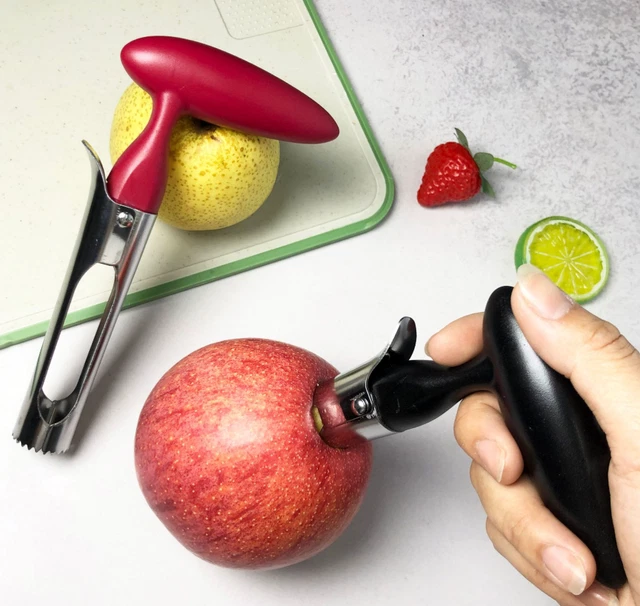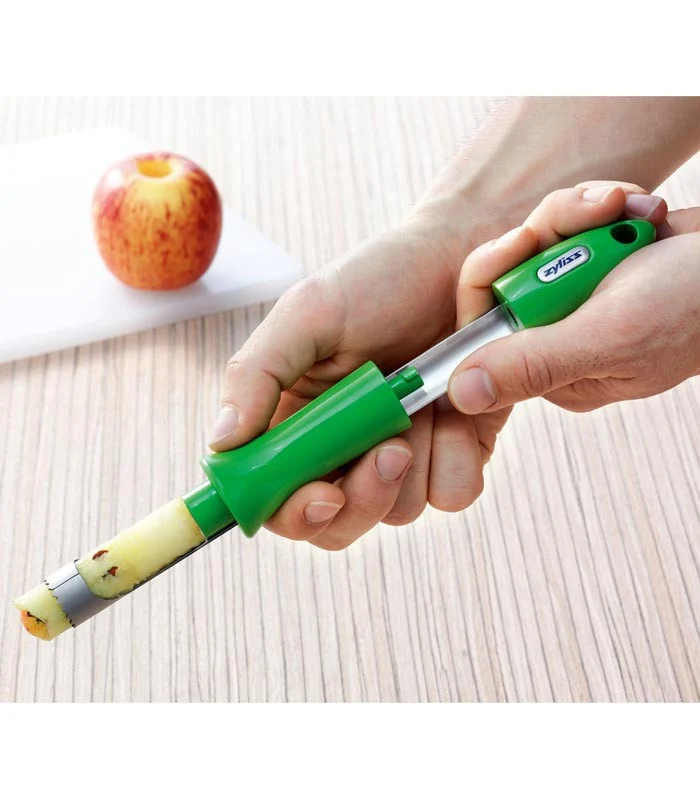
Apple Corer Size Guide: Which Size Do You Need?
A good Apple Corer Size Guide is less about the tool and more about the fruit on your counter. Pick the wrong barrel diameter and you either leave seeds behind or throw away good flesh. The right size makes prep faster and cleaner.
Most home apples fall between 2.75 and 3 inches across. Manufacturer specs show common corer bores run from 3/4-inch to 1¼-inch. That gap is enough to change waste, speed, and presentation.
That is why diameter beats brand every time.
Apple Corer Size Guide: Which Size Do You Need?
Image source: Bing (Web (fair-use with source credit))
Quick Answer
This Apple Corer Size Guide starts with bore diameter. Most home apples need a 7/8-inch or 1-inch corer. Small apples suit a 3/4-inch bore.
Large baking apples need 1¼-inch bores. Match the corer to your apple size.
Why Apple Corer Size Matters More Than Brand or Price
A corer can feel nice and still fail if the bore is wrong. The tube has to remove seeds, stem tissue, and the tough core center. It should do that without taking a large ring of good flesh.
Bore diameter is the inside cutting width of the corer tube. It decides the size of the hole left behind. A narrow bore saves flesh.
A wide bore clears cores more easily.
The U.S. Department of Agriculture grades apples by size and condition. That matters because apples are not uniform.
A Honeycrisp can be broad and dense. A small heritage apple can be narrow and firm.
Aggregate reviews often complain about stuck corers or wasted fruit. In our research, the culprit is usually size mismatch. A sharp edge helps, but it cannot fix the wrong diameter.
Corer length gets attention because it feels measurable. A 7-inch tool may look substantial. But length only matters if it matches the apple height.
A deep barrel can help with tall apples. It can also trap pulp if the tube is narrow. That is why bore and depth must be judged together.
What should you measure first?
Measure the apple across its widest point. Use a ruler or kitchen calipers. Then compare that number to the corer bore.
If the apple is under 2.5 inches wide, choose a small bore. If it is 2.75 to 3 inches wide, choose a standard bore. If it is over 3 inches wide, choose a large bore.
Quick Apple Corer Size Rule for Most Kitchens
The simplest rule is to buy for the apples you use most. For mixed grocery store fruit, a 7/8-inch or 1-inch corer covers the middle best. It removes most cores without taking excess flesh.
For baking whole apples, lean slightly larger. A 1-inch bore gives room for stuffing and handles denser fruit. For thin apple rings, lean smaller.
A 3/4-inch bore keeps the ring tidy.
As of 2026, many handheld corers are listed by total tool length. That number is less useful than bore diameter. A long corer can still have a narrow tube.
Recipe style also changes the choice. For pie slices, core after quartering if speed matters. For whole baked apples, core from the stem end.
For rings, core first, then slice.
If your fruit is very soft, choose the smaller bore and work gently. Soft apples bruise fast. A clean sharp rim helps.
If you only want one corer
Choose a 1-inch stainless steel corer. It works well for medium and large apples. It may waste a little on very small fruit, but it is the safest all-purpose pick.
If your household mostly eats small apples or crab apples, choose 3/4-inch instead. If you can a lot of large fruit, choose 1¼-inch. The best size follows your basket, not the packaging.
How Corer Diameter Affects Waste, Speed, and Core Removal
Diameter changes three things at once. It changes flesh loss, core clearance, and the force needed to push through. The tradeoff is simple.
More clearance usually means more waste.
A narrow corer removes a smaller cylinder. That leaves more usable fruit. It also makes prettier rings for dehydrating or lunch boxes.
The downside is less margin for error.
A wide corer clears seeds and stem tissue more reliably. It is faster for large batches. It also reduces the chance of the tool jamming.
The downside is a wider hole and more lost flesh.
Hand force rises as bore width rises. It also rises with firm apples. A sharp rim lowers the effort.
A wide dull corer can bruise the fruit.
Flesh loss example
Take a 3-inch apple. A 3/4-inch corer removes a small center column. A 1¼-inch corer removes a much wider column.
The second hole can be too wide for neat rings.
Manufacturer specifications often list barrel diameter, but not flesh loss. You have to infer it from the bore. Smaller bore means less removed fruit.
Larger bore means easier core ejection.
Manufacturer specifications indicate that barrel wall thickness affects ejection. Thin walls can bend. Thick walls take up more space.
A balanced tube cores cleanly without wasting fruit.
Core clearance example
A small apple may have a tight seed pocket. A 3/4-inch corer can fit that pocket well. A large apple may have a broad core.
A 1-inch or 1¼-inch corer clears it more completely.
Rinse apples before coring. The U.S. Food and Drug Administration advises washing produce under running water.
That step matters because the corer pushes surface material into the fruit.
For large batches, sort by diameter. Keep one corer for small fruit and another for large fruit. This saves time and reduces waste.
Practical signs the size is wrong
- The core comes out, but the hole looks ragged. The corer may be too wide.
- Seeds remain after coring. The bore may be too narrow or off center.
- The apple cracks when you push. The corer may be too wide or too dull.
- The tool sticks in dense fruit. The barrel may be too long, too wide, or poorly finished.
Apple Corer Size Chart by Apple Diameter
Use this chart as a starting point. Apple variety, shape, and firmness can shift the result. Always test one apple before batch prep.
Image source: Bing (Web (fair-use with source credit))
| Apple size | Apple diameter | Best corer bore | Best use |
|---|---|---|---|
| Small | 2.25 to 2.5 in | 3/4-inch | lunch rings, small fruit |
| Medium | 2.75 to 3 in | 7/8-inch or 1-inch | snacks, pies, crisps |
| Large | 3 to 3.5 in | 1-inch or 1¼-inch | stuffed apples, canning |
| Extra large | over 3.5 in | 1¼-inch or larger | batch prep, commercial use |
The chart favors fruit preservation on small apples. It favors clean core removal on large apples. That balance matches how most kitchens actually use corers.
Variety gives a useful hint. Crab apples and small heritage apples often need 3/4-inch. Gala and Fuji often fit 7/8-inch or 1-inch.
Honeycrisp and large baking apples often need 1-inch or 1¼-inch.
When the chart disagrees with your fruit, trust the fruit. Test one apple and look at the seed pockets. Adjust bore size before you prep the whole bowl.
How to read the chart
Find your usual apple diameter. If your fruit sits between two sizes, choose based on the recipe. Use the smaller bore for rings.
Use the larger bore for stuffing or dense fruit.
If you process many apples at once, sort them first. Put small fruit in one pile. Put large fruit in another.
Then match the corer to each pile.
Small-Bore Corers: Best for Small Apples and Neat Rings
Small-bore corers usually run around 3/4-inch. They are best for small apples, crab apples, and thin rings. They keep the fruit intact and reduce waste.
These corers work well for school lunches. They also suit dehydrator trays because the rings stay compact. A small hole looks cleaner on fruit platters.
The main limitation is clearance. Very large apples may not core fully. Dense varieties can also jam a narrow tube if the edge is dull.
A serrated rim helps with firm skins. A smooth rim gives cleaner edges on soft fruit. In our research, sharpness matters more than the label.
Verified buyer feedback reports that narrow corers clog more often with mealy apples. Rinse the tube between apples if pulp builds up. A narrow brush helps.
Best small-bore uses
- Small apples from farmers markets or home trees
- Crab apples for candied apples or preserves
- Thin rings for salads and garnish
- Snack prep where presentation matters
Watch for these limits
- Large apples may leave seeds near the edges.
- Hard fruit may require more hand pressure.
- Cheap narrow corers can bend if the steel is thin.
Who should avoid a small bore?
Avoid a small bore if you mostly prep large baking apples. If you need high-volume coring, a wider bore is faster. If you want one tool for every apple, choose a standard size instead.
If you mostly buy small Gala or Fuji apples, a 3/4-inch bore can be excellent. If you bake large Honeycrisp apples, keep a larger corer nearby. Small bores are precise, but they are not universal.
Standard Corers: Best All-Around Size for Baking and Snacks
Standard corers usually measure 7/8-inch to 1-inch across the barrel. That range fits most grocery store apples and gives you a safe middle ground. It clears the core without turning the center into a wide tunnel.
If you bake often, a 1-inch bore is the stronger choice. It leaves enough room for butter, sugar, or oats in stuffed apples. It also handles dense varieties with less jamming.
For snacks and fruit trays, a 7/8-inch bore can look neater. The hole stays smaller, so rings hold together better. This size also works well for pie prep when you quarter after coring.
Who should choose a standard corer?
Choose one if you buy mixed sizes and want a single tool. It is the safest default for a family kitchen. It also suits small batch crisps, muffins, and weeknight snacks.
If your apples are mostly tiny, a standard bore may remove extra flesh. If they are extra large, you may still leave seeds near the edge. In those cases, a second corer solves the problem fast.
Large-Bore Corers: Best for Big Apples, Canning, and Stuffed Apples
Large-bore corers usually run 1¼-inch or wider. They are built for big fruit and high-volume prep. The wider tube clears seeds, stem tissue, and tough centers in one pass.
This size shines for canning apple rings. It also works well for stuffed baked apples because the cavity stays open. If you process orchard fruit by the box, the speed gain matters.
The tradeoff is flesh loss. A wide corer removes more good apple around the core. On small fruit, that waste becomes obvious very quickly.
When is a large bore the right call?
Use a large bore when your apples are over 3 inches wide. Use it when core clearance matters more than perfect rings. Use it when you need fast throughput for canning or catering.
Aggregate buyer feedback reports that large corers can split smaller apples. The tool forces the fruit outward as it cuts. Sort by size first, then match the corer to the pile.
Handheld Corer vs Peeler-Corer-Slicer vs Knife Coring
A handheld corer is best for control and storage. It takes little space and works on individual apples. It is the easiest option for quick snacks and small baking projects.
A countertop peeler-corer-slicer is best for volume. It peels, cores, and slices in one motion. It also gives uniform rings for dehydrators and pie prep.
A paring knife is best when you only have a few apples and no corer. It can remove the core after quartering. It gives more control over odd shapes, but it is slower and less consistent.
Which method fits your kitchen?
Choose a handheld corer if you want simple cleanup and low cost. Choose a peeler-corer-slicer if you process large batches often. Choose a knife if you value precision and already have good knife skills.
Manufacturer specs show countertop models often use fixed corer rods. Those rods may not suit every apple size. Check the corer diameter before buying if waste matters.
Apple Corer Size Comparison Table
Use this comparison to choose by outcome, not by tool length. The best bore depends on how much flesh you want to save and how clean the core removal must be.
| Corer size | Typical bore | Flesh loss | Core clearance | Best for |
|---|---|---|---|---|
| Small | 3/4-inch | Low | Fair on large fruit | small apples, neat rings |
| Standard | 7/8-inch to 1-inch | Moderate | Good for most fruit | baking, snacks, pie prep |
| Large | 1¼-inch | Higher | Excellent | canning, stuffed apples |
| Extra large | over 1¼-inch | High | Best for big fruit | orchard batches, commercial prep |
The table favors small bores for fruit preservation. It favors large bores for speed and reliability. Most homes get the best balance from the standard row.
If you are between sizes, think about texture. Soft apples bruise easier with wide tools. Firm apples tolerate a larger bore better.
Best Apple Corer Size by Use Case
Match the corer to the job, not just the apple. The same fruit can need a different size for rings, baking, or canning.
- Whole baked apples: 1-inch bore for medium fruit, 1¼-inch for large fruit.
- Apple rings for snacks: 3/4-inch for small fruit, 7/8-inch for medium fruit.
- Pie slices: 7/8-inch or 1-inch, then quarter and slice.
- Dehydrator rings: 3/4-inch or 7/8-inch for compact, even circles.
- Canning rings: 1-inch or 1¼-inch for fast core clearance.
- Stuffed apples: 1-inch or 1¼-inch to leave a clean cavity.
- Kids lunch prep: 7/8-inch for balance between safety and neat shape.
- Soft apples: smaller bore with a sharp rim to reduce bruising.
What if you prep many different sizes?
Keep two corers if you cook seasonally. Use a 3/4-inch tool for small fruit. Use a 1-inch tool for medium and large fruit.
For serious preserving, add a 1¼-inch corer. That covers extra-large fruit without forcing a narrow tube through a wide core. This small toolkit cuts waste and speeds batch work.
Common Sizing Mistakes That Waste Apple Flesh
The most common mistake is buying by total tool length. A 7-inch corer can still have a narrow bore.
Another mistake is using one oversized corer for every apple. It may clear cores fast, but it removes good flesh from small fruit.
- Ignoring apple diameter before batch prep
- Choosing a wide bore just to avoid jams
- Coring off-center and leaving seeds behind
- Using a dull rim that crushes soft fruit
What to Check After Size: Steel, Grip, Edge, and Cleanup
Once the bore size fits your apples, look at build quality. Stainless steel resists rust and is usually the easiest choice for home kitchens. Carbon steel can hold an edge well, but it needs prompt drying.
- Handle: Choose a soft grip that will not slip when wet.
- Rim: A sharp cutting edge lowers bruising and hand pressure.
- Barrel: Smooth interior walls help the core eject cleanly.
- Cleanup: Narrow tubes need a small brush for pulp.
Safety, Cleaning, and Maintenance Tips for Any Corer Size
Treat the cutting rim like a knife. Keep fingers away from the barrel edge, and never push a corer through frozen fruit. Use a stable board under the apple if you need extra control.
Rinse the tool right after use. Apple juice is sticky and can trap pulp inside the tube. Dry carbon steel at once to prevent rust.
Store corers with the rim protected. A drawer insert or blade guard helps.
Final Apple Corer Size Recommendation
For most kitchens, choose a 1-inch stainless steel corer. It handles medium and large apples well and leaves room for stuffed apples.
If you mostly buy small apples, add a 3/4-inch corer. If you can large fruit often, add a 1-1/4-inch corer.
Frequently Asked Questions
What size apple corer is best for most home kitchens?
A 1-inch corer is the best all-around size for most home kitchens. It fits medium and large apples, clears seeds reliably, and leaves enough space for stuffed apples. It does waste a little flesh on very small fruit, but that is usually acceptable.
What size corer do you need for small apples?
Small apples usually need a 3/4-inch corer. This size removes the core without taking too much flesh. It works well for crab apples, lunch rings, and small heritage varieties.
If the apple is firm, a sharp rim helps prevent splitting.
Is a wider apple corer always better?
No. A wider corer clears cores faster, but it also removes more usable fruit. It can split small apples and leave oversized holes in rings.
Choose the bore by apple diameter and recipe, not by assuming wider tools perform better.
Do you need more than one apple corer size?
Not always. One 1-inch corer covers most everyday prep. If you regularly process small fruit or large canning apples, a second size saves time and reduces waste.
A 3/4-inch and 1-1/4-inch pair covers most seasonal home fruit kitchens very well.