
Common Uses for a Cherry Pitter Beyond Pitting Cherries
Common Uses for a Cherry Pitter usually center on speed, cleaner fruit, and fewer missed pits. A cherry pitter is a small tool that pushes the stone out through the stem end. It works best on firm, washed cherries.
It also keeps the fruit more presentable than hacking with a knife.
A pound of fresh cherries usually yields about 2.5 to 3 cups of pitted fruit. Pit and stem waste can run 10 to 20 percent by weight. That is why method choice matters before you start.
Let's start with the short answer.
Common Uses for a Cherry Pitter Beyond Pitting Cherries

Image source: Bing (Web (fair-use with source credit))
Quick Answer
The Common Uses for a Cherry Pitter include pies, jams, canning, drinks, freezing. It removes pits faster than a knife. It keeps cherries whole for baking.
It reduces juice splatter and hand strain. It suits small bowls or large batches.
Why Comparing Cherry Pitter Uses Matters Before You Buy
A cherry pitter is not just a novelty tool. It solves a specific problem. You want the pit out while the cherry stays usable.
The method changes the result.
The biggest difference is volume. If you pit a handful for yogurt, a small handheld pitter is fine. If you process several pounds for pie or jam, the wrong tool gets old fast.
Aggregate reviews often report hand fatigue with squeeze models.
They also report missed pits when cherries are very soft. That matters because one stray pit can ruin a bite of pie. It can also crack a tooth.
A pitter is useful, but it is not automatic.
Use matters too. A pitter is a strong choice for whole fruit desserts. It is less useful if you want a smooth sauce.
In that case, a food mill may do more.
Here are the main conditions that decide the right tool:
- Batch size: a cup, a few pounds, or a full harvest
- Fruit type: sweet Bing cherries, tart Montmorency cherries, or small ornamental fruit
- Fruit condition: firm and cold, soft and ripe, or bruised
- End use: pie, jam, canning, freezing, cocktails, or fresh snacks
- Cleanup tolerance: quick rinse or full disassembly
The tool also changes waste. A good pitter sends pits to one side. A knife sends pits, juice, and flesh into a pile.
That matters when you measure yield.
If a recipe needs three cups of pitted cherries, a messy method can make you buy more fruit. It can also slow you down. That is especially true during summer cherry season when fruit comes in fast.
If the job is small and the fruit is firm, a simple plunger or squeeze model works. If the job is large and speed matters, a crank model with a hopper makes more sense. If the fruit is overripe, every method gets messy.
A pitter can still work with soft fruit, but you should expect more splatter and more fruit damage. The common uses stay similar. The right tool changes with the situation.
| Use | What you need from the pitter |
|---|---|
| Pie or galette | Whole fruit and low bruising |
| Jam | Speed and clean pit separation |
| Canning | Batch consistency and easy cleanup |
| Cocktails | Neat garnish and minimal juice loss |
How Cherry Pitters Work and Why Design Changes the Result
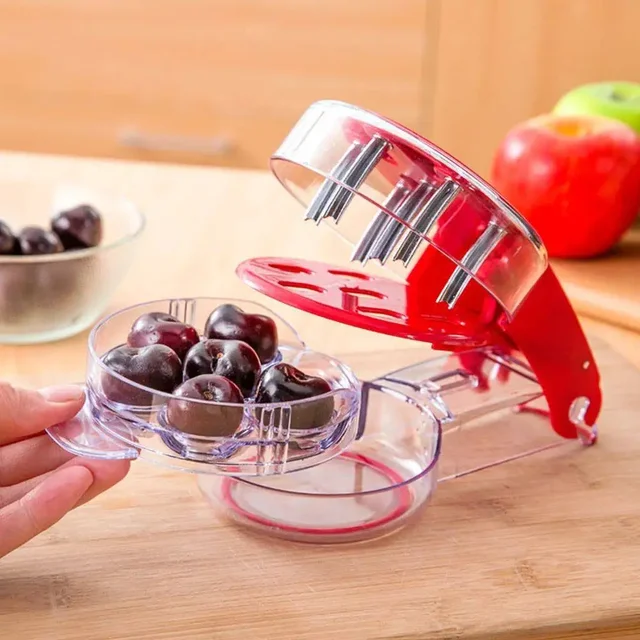
A cherry pitter, also called a cherry stoner or fruit pitter, removes the stone without cutting the cherry open. Most manual models use a seat, a plunger, and a spring return. You place one cherry in the seat.
You press or crank.
The rod pushes the pit out through the opposite side. The fruit drops into a bowl. The pit falls into a chute or catcher.
That basic idea stays the same across tools.
Design changes the experience. A handheld plunger tool is compact. A hinged squeeze tool works like pliers.
A countertop crank pitter adds a hopper, a crank, and often a pit chute.
Manufacturer specifications often list stainless steel rods, spring returns, and suction bases. Those details matter more than color or shape. Stainless steel parts resist rust and handle acidic juice better.
Cheap plastic parts can crack over time. Springs can trap fruit flesh. Narrow pits can jam small chutes.
These are small design points, but they decide whether the tool stays useful.
The fruit itself sets limits. Sweet cherries often measure 18 to 28 mm across. Tart cherries often measure 12 to 18 mm across.
Pits often measure 8 to 13 mm.
If the tool seat is too wide, small cherries slip. If the plunger is too large, firm fruit can split. Good alignment reduces missed pits.
The pit should sit in line with the rod.
Many tools work best when the stem scar faces one direction. Cold fruit holds shape better. Warm fruit crushes easier.
That is why many cooks chill cherries before big prep sessions.
The main parts to compare are:
- Seat or cradle that holds the cherry
- Plunger or rod that drives the pit out
- Spring return that resets the tool
- Pit chute or catcher that separates waste
- Base or clamp that keeps the tool steady
Cleaning is part of the design too. Tools with open springs and deep crevices trap flesh. Juice dries fast.
A quick rinse helps.
Models with fewer parts usually clean faster. That matters when you are processing a large bowl of fruit. Sticky residue builds up quickly.
Wash cherries first, because the U.S. Food and Drug Administration advises rinsing produce under running water. If you plan to can cherries, use tested guidance from the National Center for Home Food Preservation.
A pitter speeds prep, but it does not replace safe canning steps.
Some tools also handle small olives, dates, or kumquats. This only works when the fruit size matches the seat. A tool that handles many fruits is useful, but size compatibility still rules.
Handheld Squeeze Pitters vs Countertop Crank Pitters
Handheld squeeze pitters and countertop crank pitters serve different jobs. A squeeze pitter is best for light prep. A crank pitter is best for batch work.

Image source: Bing (Web (fair-use with source credit))
A handheld squeeze pitter works like a small pair of pliers. You load one cherry, squeeze, and release the pit. It is cheap and easy to store.
As of 2026, basic handheld pitters usually sell for about $6 to $20.
They suit a pie, a small jam batch, or a bowl of snack cherries. They also suit people with small kitchens. There is little setup and little cleanup.
You can rinse one in the sink and toss it in a drawer.
A countertop crank pitter works faster. It often uses a suction base or clamp. You fill a hopper, turn the handle, and cherries pass through one after another.
These models often cost about $20 to $80.
Heavy duty versions can cost more. They take more storage space. They also need a stable counter.
If the suction base slips, the whole process slows down.
| Tool type | Best for | Main limit |
|---|---|---|
| Handheld squeeze pitter | Small batches, garnishes, quick pies | Slower and can tire your hand |
| Countertop crank pitter | Large batches, canning, freezer prep | Takes more storage space |
Which one fits your batch?
Your batch size decides this faster than brand does. If you pit one or two cups at a time, a handheld model is enough. If you process five pounds or more, a crank model saves effort.
Aggregate reviews point to a few common tradeoffs. Handheld tools can spray juice if the cherry is very ripe. Small models may also struggle with very large or very small fruit.
Crank tools need stable setup. They also need more cleaning. The crank may jam if stems are left on.
That means you still need to sort and stem the fruit first.
Manufacturer specs can help you judge fit. Look for fruit size compatibility, pit chute design, and dishwasher safe parts. If you have limited hand strength, a crank model may be easier.
If you have a tiny kitchen, a handheld tool may be the only one you will keep out. That is a fair reason to choose it. The best tool is the one you will actually use.
Before buying, check these practical points:
- Does the seat fit both small tart cherries and large sweet cherries?
- Does the tool have a splash guard or open chute?
- Can you reach the spring and rod for cleaning?
- Does the base stay put on a smooth counter?
- Are replacement parts available?
A pitter also helps people who avoid knives. A paring knife can slip on a round cherry. A pitter keeps fingers away from the blade.
That makes it a sensible choice for quick snack prep.
Cherry Pitter vs Knife, Straw, Toothpick, Chopstick, and Food Mill
A cherry pitter is not the only way to remove a cherry pit. Many kitchens start with a knife, a straw, a toothpick, or a chopstick. Each method has a role.
The difference comes down to speed, control, and fruit shape. A pitter is built for whole fruit. The other tools are backups or specialty methods.
A paring knife gives control. You cut around the pit and twist. This works for firm cherries.
It is slow.
It also creates more cut surfaces, so the fruit loses shape and juice. That is fine for sauce. It is not ideal for a cherry tart where you want neat halves.
A straw can push a pit out from the stem end. It works in a pinch. It is best for a few cherries over ice cream.
It can slip.
It also bruises soft fruit. The trick works better with firm cherries. It is not a good batch method.
A toothpick works like a tiny probe. It can loosen a pit, but it offers little leverage. A chopstick gives more push, but it still depends on hand control.
Both methods can splash juice. They also work slowly. They are fine for a garnish, but not for a pie.
A food mill is a different category. It presses fruit through a screen. It removes skins and seeds.
It is great for sauce.
It will not give you whole pitted cherries for a pie or galette. That is the key distinction. A food mill changes texture.
A cherry pitter preserves shape.
Many olive pitters are sold as cherry and olive pitters. They can work for small cherries. Large sweet cherries may not seat well.
Check the tool size before assuming it will handle Bing cherries.
Some cooks use a stand mixer paddle to knock pits from large batches. This can work with very ripe fruit. It damages the cherries.
It is better when the fruit will be cooked anyway.
| Method | Best use | Main downside |
|---|---|---|
| Cherry pitter | Whole fruit for baking and drinks | Can crush very soft cherries |
| Paring knife | Small prep with firm fruit | Slow and higher slip risk |
| Straw or toothpick | A few cherries with no tool | Weak control and mess |
| Food mill | Sauce, puree, and smooth prep | Does not keep fruit whole |
So who should choose what? Choose a cherry pitter if the cherries need to stay whole. Choose a knife if you only have a few firm cherries and a cutting board.
Choose a straw or toothpick for a quick garnish. Choose a food mill if you want a smooth result and do not care about shape. Choose the method based on the final dish.
In our research, the biggest mistake is treating these methods as equal. They are not. A pitter is a prep tool for whole fruit.
A food mill is a finishing tool for texture. A knife is a fallback. A straw is a trick.
Knowing that saves time and keeps your dessert from turning into cherry mush.
Side-by-Side Comparison: Speed, Mess, Fruit Damage, and Cleanup
The fastest method is not always the cleanest method. A crank pitter wins on volume. A handheld pitter wins on storage.
A knife wins when you want no extra gear.
| Method | Speed | Mess level | Fruit damage | Cleanup |
|---|---|---|---|---|
| Handheld squeeze pitter | Moderate | Low to moderate | Low on firm fruit | Quick rinse |
| Countertop crank pitter | High | Moderate with overripe fruit | Low to moderate | More parts to wash |
| Paring knife | Slow | Moderate | Higher due to cuts | Board and knife wash |
| Straw or toothpick | Very slow | Low for a few cherries | Can bruise soft fruit | Almost none |
Choose a crank model when you have pounds of fruit. Choose a squeeze model when you want one small drawer tool. Choose a knife only for small jobs where shape matters less.
Choose a straw for a garnish, not a pie.
Cleanup changes with juice. Cherry juice stains fast. Rinse the pitter before the sugars dry.
Models with open springs need a small brush.
Common Uses for a Cherry Pitter: Baking, Jam, Canning, Drinks, and Freezing
The best use depends on the final texture. Whole cherries need a pitter. Smooth sauces need a mill.
Baking
A cherry pitter is ideal for pies, galettes, clafoutis, and muffins. It keeps cherries intact so they hold shape during baking. Firm Bing cherries work well.
Chill them first for cleaner pits.
Jam and preserves
Jam benefits from speed more than perfect shape. A crank pitter moves fast through large bowls. You still need to check for stray pits.
Tart Montmorency cherries often pit cleanly when cold.
Canning
Canning needs consistency. A pitter gives uniform fruit for jars. It also keeps syrup clearer than chopped fruit.
Follow tested canning steps for safe storage.
Drinks and garnishes
Cocktails and mocktails need neat cherries. A pitter keeps the skin mostly closed. That helps garnishes look clean.
It also reduces juice loss in the prep bowl.
Freezing
Freezer prep is one of the strongest uses. Pit the cherries, spread them on a tray, then bag them. This gives you ready fruit for smoothies and crisps.
Frozen pitting is harder, so pit before freezing.
When a Cherry Pitter Is Not the Best Choice
A cherry pitter is not the right tool for every cherry job. It struggles with very soft fruit. It also does not make purees.
If you want smooth sauce, use a food mill. If you only need a few chopped cherries, a knife may be faster. If you bought frozen pitted cherries, skip the tool entirely.
A pitter can also be a poor fit for mixed fruit sizes. Small wild cherries may slip through the seat. Very large cherries may split before the pit releases.
If the fruit is bruised or fermenting, no pitter will save it. Sort first. Discard split or moldy fruit.
Use the pitter only on fruit that still has structure.
For commercial volume, a manual pitter may not keep up. Commercial kitchens may need heavier equipment. For most home cooks, the limit is patience, not skill.
Common Mistakes That Leave Pits Behind or Crush the Fruit
Most failures come from setup, fruit condition, or speed. The tool works best when the cherry sits centered in the seat.
Avoid these common mistakes:
- Leaving stems on, which can jam the chute
- Using warm cherries, which crush easily
- Loading two cherries at once
- Skipping a final pit check
- Letting juice dry on the spring
- Forcing the crank through hard resistance
If pits remain, slow down and realign the fruit. The stem scar should face the plunger. If fruit crushes, chill it for 20 to 30 minutes.
Cold flesh resists collapse.
If the crank jams, stop. Clear the pit chute and check for stem bits. For handheld tools, rinse the rod often.
Sticky buildup causes missed pits.
Safety Warnings: Pit Fragments, Choking Risk, and Amygdalin
Cherry pits can crack teeth. They also pose a choking risk for young children. Always check pitted fruit before serving raw or baking.
Pit fragments matter too. A broken pit can hide inside the flesh. Give pitted cherries a quick visual scan.
For kids or older adults, cut cherries in half after pitting.
Do not eat crushed or chewed cherry pits in quantity. They contain amygdalin, which the body can convert to cyanide. An occasional swallowed whole pit usually passes, but intentional pit eating is not safe.
Keep fingers clear of crank mechanisms. A pitter uses pressure, and pressure can pinch skin. Supervise children near fruit prep.
If you can cherries, sanitize tools and jars. Safe preservation depends on tested methods, not just clean fruit. A pitter helps prep, but it does not make canning safer by itself.
What to Look for in a Cherry Pitter Before Buying
Choose stainless steel parts, a stable base, and a seat that fits small and large cherries. Check cleanup access.
Expert Tips for Faster, Cleaner Cherry Pitting
Chill cherries. Stem them first. Work over a bowl.
Rinse the rod often. Inspect every batch.
Quick Decision Guide by Use Case
Small jobs: handheld. Large batches: crank. Smooth sauce: food mill.
FAQs About Common Cherry Pitter Uses
Can you pit frozen cherries?
No. Pit fresh cherries before freezing.
Does a cherry pitter work on olives?
Sometimes, if sizes match the seat.
What cherries pit best?
Firm, cold sweet or tart cherries.
Is a cherry pitter worth it?
Yes for baking, jam, drinks, and batch prep.
Final Verdict: Which Cherry Pitter Method Fits Your Kitchen
Buy a handheld pitter for occasional pies. Choose a crank pitter for canning or freezer batches.