Can Silicone Baking Mats Really Replace Baking Trays?
You've got a silicone mat in one drawer and a scratched, warped tray in the cupboard. So the obvious question: can silicone baking mats replace baking trays? The short answer is no, and the confusion makes total sense.
Most of us first met a silicone mat as a swap for parchment paper, and parchment gets thrown away, so it feels like a replacement for something.
But a mat and a tray do completely different jobs. Manufacturer specifications put most food-grade silicone mats at roughly minus 40°C to 250°C (480°F), and none of them are rated to sit on an oven rack alone. That single spec tells you everything about how the two work together.
Here's what's actually going on.
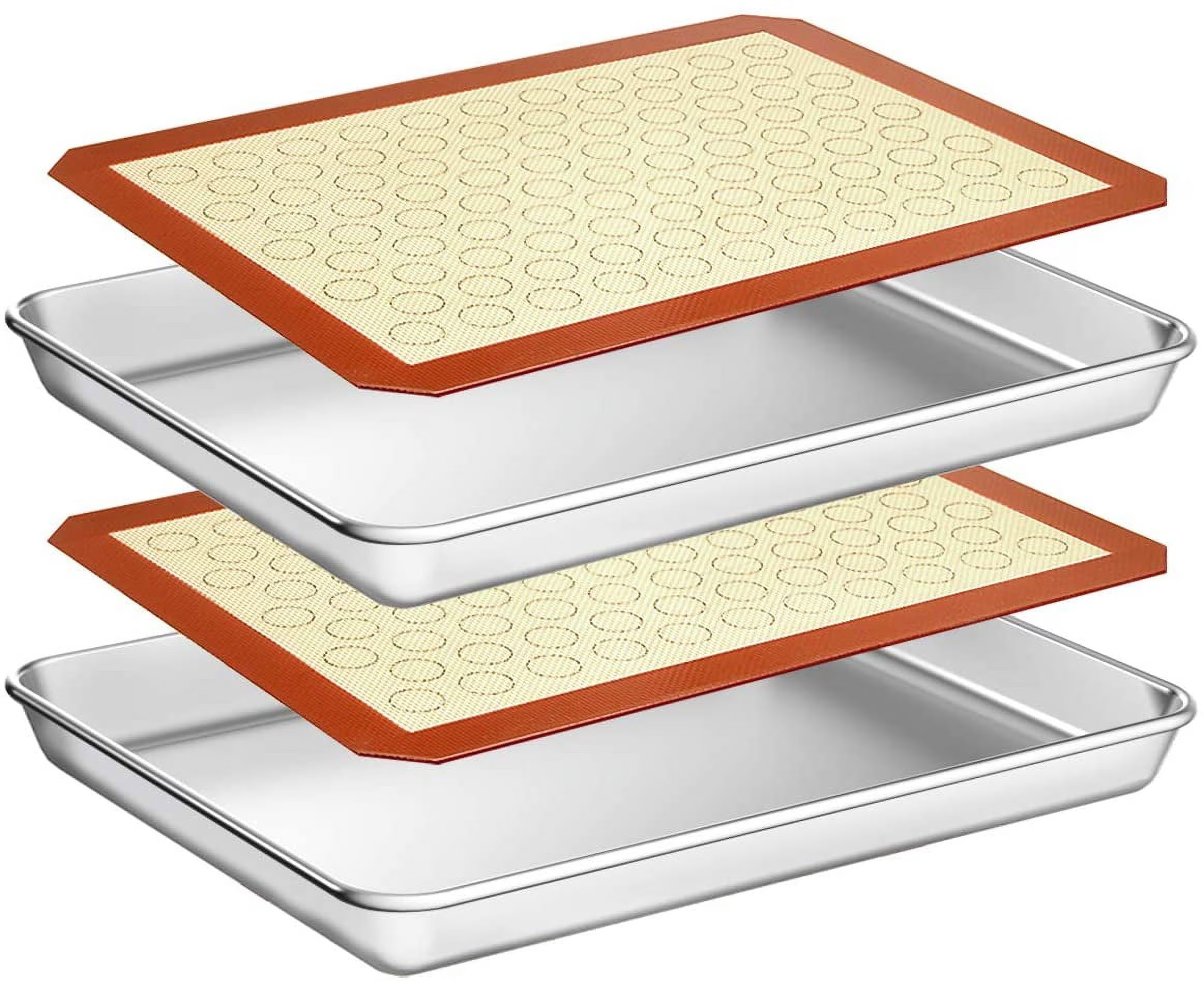
Image source: Bing (Web (fair-use with source credit))
Quick Answer: A Mat Is a Liner, Not a Pan
No, a silicone baking mat cannot replace a baking tray. A mat is a flexible liner with no rim and no rigidity. It always needs a rigid tray underneath to hold its shape.
Mats replace parchment paper, grease and non-stick spray. Trays hold the food, contain fat and conduct heat.
Why People Ask This in the First Place
Three things push people toward this question, and all three are reasonable.
- Cupboard space. Trays are bulky. A mat rolls up. If a mat did the same job, that's a real win.
- The parchment comparison. Mats are sold as the reusable, zero-waste swap for baking paper. It's a small mental jump from "replaces paper" to "replaces the pan".
- Ruined trays. Once a non-stick coating flakes or a cheap tray warps, people look for a workaround instead of buying new.
There's also genuine crossover in the product world. Silicone bakeware includes moulds, loaf pans and muffin trays that genuinely are pans. Those hold shape because they're thick and often have a rigid frame.
A flat mat is a different product entirely, and mixing the two up is where most of the confusion starts.
What a Silicone Baking Mat Actually Does
:max_bytes(150000):strip_icc()/faw-silpat-baking-mat-stella-totino-11-2c02590b941142c69be9a1a37b62afab.jpeg)
Image source: Bing (Web (fair-use with source credit))
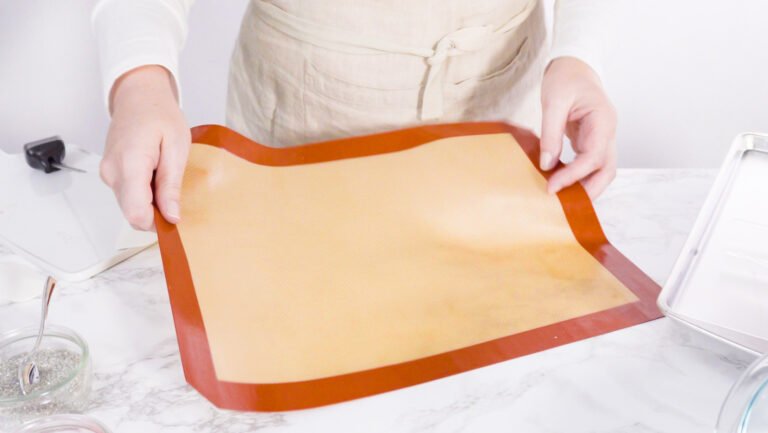
A silicone baking mat is a thin, flexible sheet of food-grade silicone, usually around 0.7mm to 1.2mm thick, that sits on top of a baking tray to give you a non-stick surface.
:max_bytes(150000):strip_icc()/faw-silpat-baking-mat-stella-totino-11-2c02590b941142c69be9a1a37b62afab.jpeg)
Image source: Bing (Web (fair-use with source credit))
Its whole reason for existing is release. Caramel, meringue, macarons, sticky enriched doughs, toffee, tuiles. All the stuff that welds itself to metal comes away clean from silicone.
The Fibreglass Core and What's Inside a Good Mat
Better mats aren't pure silicone. They have a woven fibreglass mesh sandwiched inside, which is why they lie flat instead of curling and why they hold their dimensions after hundreds of bakes. If you look closely at a quality mat in good light, you can see the faint grid pattern through the surface.
Cheap unbranded mats often skip the mesh or bulk out the silicone with fillers. Those are the ones that bubble, delaminate and smell odd on first heating. A quick sanity check: pinch and twist a corner.
If a white streak appears, there are fillers in there.
The polymer itself is polydimethylsiloxane, and food-contact rubber articles for repeated use in the US fall under 21 CFR 177.2600, published by the US Food and Drug Administration. In Europe, look for LFGB testing on the packaging.
Why a Mat Needs Something Rigid Underneath
Pick up a loaded mat by one edge and it folds. That's not a flaw, it's the design.
- It has no walls, so nothing stops liquid running off.
- It has no structure, so it can't be lifted or carried when full.
- It can't go directly on an oven rack. It will sag through the bars and dump your food.
- It can't go under a grill or broiler, near an element, or on a hob. Every major manufacturer says this plainly.
What a Baking Tray Does That a Mat Can't
The tray is the vessel. It's the thing doing the structural and thermal work, and a mat can't stand in for either job.
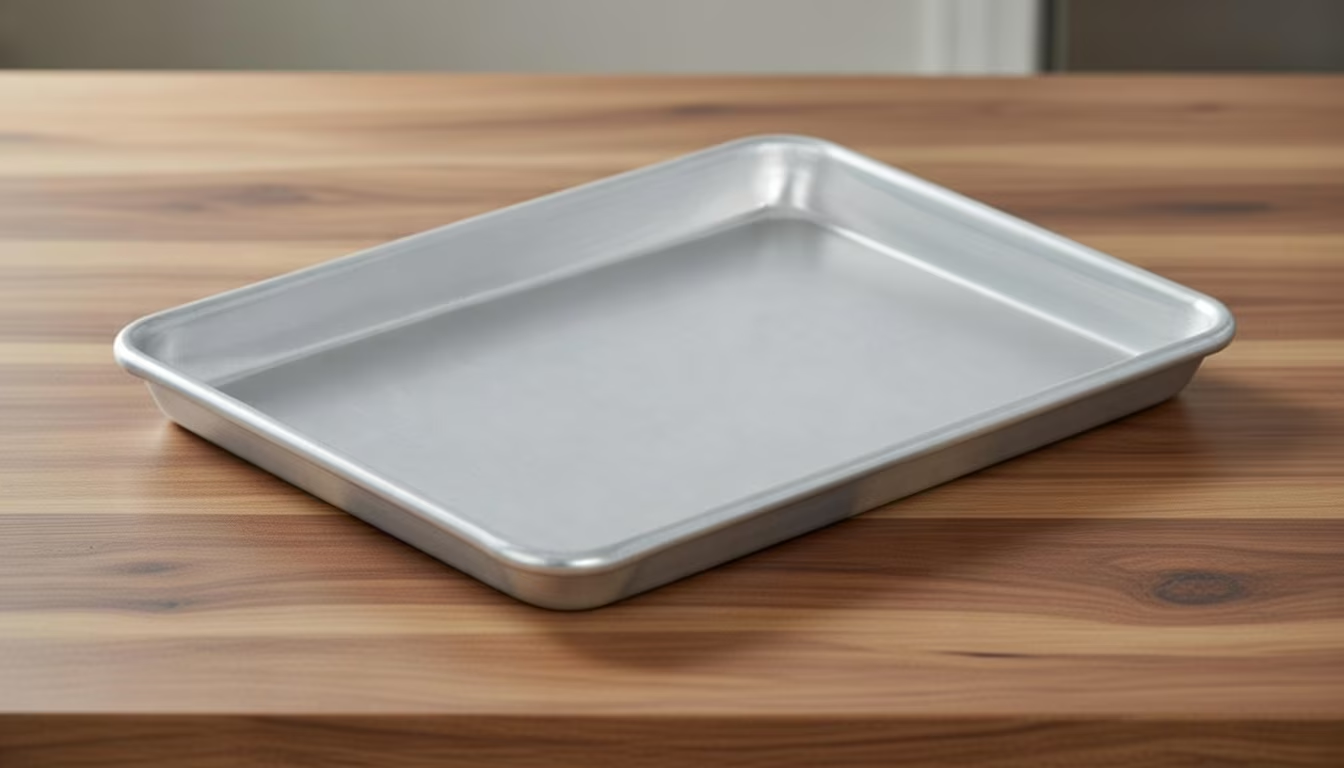
Image source: Bing (Web (fair-use with source credit))
Rims, Edges and Holding Liquid
That raised lip on a rimmed sheet pan isn't decoration. It contains rendered bacon fat, roasting-oil runoff, syrup, marinade and anything that liquefies at temperature.
A flat mat has nowhere for that to go except over the side and onto the oven floor. Best case, smoke and a scrubbing job. Worst case, hot fat on a heating element.
That's a genuine fire risk, not a theoretical one.
Metal Contact, Browning and Crisping
This is the part most people miss. Aluminium conducts heat at roughly 200 W/m·K. Silicone rubber sits around 0.2 W/m·K.
That's a thousandfold difference.
So a mat is, thermally speaking, a thin insulating blanket between your food and the hot metal. It softens bottom heat. Sometimes that's exactly what you want.
Often it isn't.
Silicone Mat vs Baking Tray: Side-by-Side
| Factor | Silicone baking mat | Baking tray |
|---|---|---|
| What it is | Flexible liner | Rigid vessel |
| Holds shape when loaded | No | Yes |
| Contains fat and liquid | No rim | Rimmed pans do |
| Heat conduction | Very low (insulating) | Very high |
| Direct oven rack use | Never | Yes |
| Max temperature | About 230–260°C | 250°C+ (metal limits, not coating) |
| Browning the base | Reduces it | Drives it |
| Lifespan | 3–8 years typical | 10+ years for bare aluminium |
| Replaces | Parchment, grease, spray | Nothing else does its job |
Read that table one way and the verdict writes itself. As of 2026, there's no flat silicone mat on the market designed to work without a pan beneath it. They're partners, not rivals.
Silicone Mat vs Parchment Paper vs Foil vs Greased Tray
:max_bytes(150000):strip_icc()/__opt__aboutcom__coeus__resources__content_migration__serious_eats__seriouseats.com__2019__03__20190131-silpat-vs-parchment-paper-cookie-baking-vicky-wasik-silpat-tates-chocolate-chip-cookies-1500x1125-11a157b18369497faf7f3c804c74425c.jpg)
Image source: Bing (Web (fair-use with source credit))
This is the comparison that actually matters, because all four are liners. Each one changes how the base of your food cooks.
:max_bytes(150000):strip_icc()/__opt__aboutcom__coeus__resources__content_migration__serious_eats__seriouseats.com__2019__03__20190131-silpat-vs-parchment-paper-cookie-baking-vicky-wasik-silpat-tates-chocolate-chip-cookies-1500×1125-11a157b18369497faf7f3c804c74425c.jpg)
Image source: Bing (Web (fair-use with source credit))
| Liner | Bottom browning | Best for | Watch out for |
|---|---|---|---|
| Silicone mat | Softest | Macarons, meringue, sugar work, sticky doughs | Pale bases, extra spread |
| Parchment paper | Moderate | Cookies, cakes, most general baking | Curls in fan ovens, single use |
| Aluminium foil | Strongest | Roasting, high-heat veg, easy cleanup | Sticking, tearing, acidic food reacts |
| Greased bare tray | Strongest | Crisp-bottomed biscuits, scones | Burnt-on residue, hard scrubbing |
A visual comparison shows this clearly. Two trays of identical cookie dough, one on a mat and one on parchment. The parchment batch comes out slightly taller with a deeper golden base.
The silicone batch spreads wider and stays paler underneath.
Neither is wrong. It depends what you're baking and what you want.
Where Silicone Mats Genuinely Win
Mats earn their place in specific jobs, and in those jobs nothing else comes close.
- Sugar work. Caramel, brittle, praline and isomalt peel straight off. Parchment tears and sticks.
- Macarons and meringue. The gentle bottom heat stops feet from over-baking and bases from browning.
- Sticky enriched dough. Cinnamon rolls, hot cross buns and anything with a syrup glaze release cleanly.
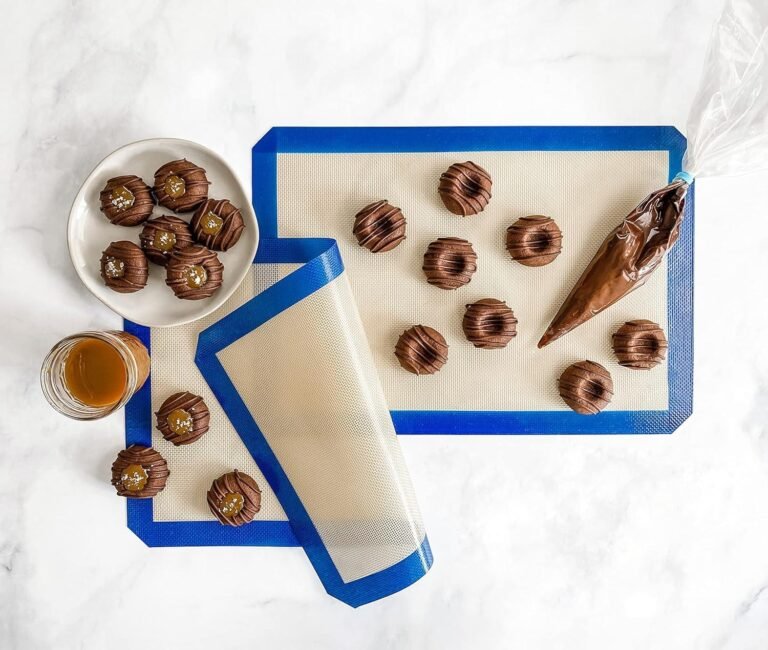
- Chocolate work. Set tempered chocolate straight onto the mat for shards and garnishes.
- Piping accuracy. Printed guide mats keep macarons and éclairs uniform without eyeballing it.
- Protecting old trays. A mat hides existing stains and keeps acidic or sugary mixtures off worn metal.
There's a waste angle too. Manufacturer claims of 2,000 to 3,000 bake cycles are optimistic for home use, but aggregate reviews suggest three to eight years of regular use is realistic. That's a lot of parchment rolls you don't buy.
Where Silicone Mats Let You Down
Now the honest half. Mats fail in predictable ways, and almost all of it traces back to that insulation gap we covered earlier.
Pale Cookie Bottoms and Extra Spread
Cookies baked on silicone come out flatter and lighter underneath. The mat slows heat into the base, so the dough stays soft longer and spreads before it sets.
Fixes that work:
- Chill the dough properly, 30 minutes minimum, before scooping.
- Move the tray to the lower third of the oven.
- Add 10°C (or about 25°F) and expect 1 to 3 minutes extra bake time.
- If you want thick, chewy cookies with a crisp base, use parchment instead.
Soggy Roast Veg and Wet-Bottomed Pastry
Roasting is where mats really disappoint. Potatoes, carrots and cauliflower need direct contact with screaming-hot metal to crisp. A mat blocks that contact and traps the moisture the vegetables release.
Same story with pastry. Tart shells, quiches and pizza bases need aggressive bottom heat to set the crust. On a solid mat you get a pale, damp floor.
If you want a mat for bread and tarts, use a perforated one instead. Perforated mats (sold as Silpain or air mats) let steam escape and give a much better crust.
Fat, Grease and Sugar Runoff
Anything that renders a lot of fat is a bad match. Bacon, sausages, chicken thighs and salmon all release liquid, and a flat mat gives it nowhere to sit.
The mat itself also absorbs a thin oil film over time. That's what causes the tacky, slightly greasy feel that survives a normal wash. It's the most common complaint in verified buyer feedback.
Best Uses for Each: A Quick Match-Up Guide
Straight if/then logic. Find your bake, use the right setup.
| What you're making | Use this |
|---|---|
| Macarons, meringue, tuiles | Mat on a rimmed tray |
| Caramel, brittle, toffee | Mat on a rimmed tray |
| Drop cookies, standard batches | Parchment on a tray |
| Thick chewy cookies with crisp base | Parchment or lightly greased tray |
| Roast vegetables and potatoes | Bare tray or foil, no mat |
| Bacon, sausages, high-fat meat | Rimmed tray, wire rack, no mat |
| Pizza, tart shells, pastry | Bare tray, baking steel or stone |
| Bread rolls and baguettes | Perforated silicone mat |
| Sheet-pan dinners | Bare or foil-lined rimmed tray |
| Toasting nuts and seeds | Bare tray |
| Rolling and kneading dough | Silicone pastry mat on the worktop |
If you only own one tray, buy a rimmed half sheet in bare aluminium. Then add a mat for the sticky jobs. That combination handles nearly everything.
Heat Ratings, Sizes and Specs Worth Knowing
Two specs decide whether a mat works for you: temperature rating and size.
Most food-grade mats are rated to somewhere between 230°C and 260°C (450°F to 500°F). Silpat, the original fibreglass-reinforced mat, is specified from minus 40°C to 250°C. Grill and broiler elements run well past that, which is why grilling on a mat is off the table.
Sizing catches people out constantly, especially between markets.
| Pan | Dimensions | Mat that fits |
|---|---|---|
| US half sheet | 46 x 33 cm (18 x 13 in) | 42 x 29.5 cm |
| European half sheet | 40 x 30 cm | 38 x 28 cm |
| Quarter sheet | 33 x 23 cm (13 x 9 in) | 30 x 21 cm |
The mat should sit inside the rolled rim, not ride up over it. A mat that's slightly too big buckles at the edges and tips food toward the middle.
Tray gauge matters as well. 18-gauge aluminium (around 1.2mm) is the home standard. 13-gauge (about 2.3mm) is heavier, resists warping and holds heat more evenly. If your tray pings and buckles in a hot oven, it's too thin, and no mat will fix that.
Safety Rules You Shouldn't Bend
A few of these are non-negotiable. Get them wrong and you risk a burn, a smoking oven or a grease fire.
- Never bake a mat without a rigid tray beneath it. No exceptions.
- Never place a mat on an oven rack, an element, a hob or under a grill.
- Never exceed the printed temperature rating. If there isn't one on the packaging, don't buy the mat.
- Don't cut on it. A knife or pizza wheel exposes the fibreglass mesh, and that mat is finished.
- Bin damaged mats. Tears, bubbling, delamination or exposed mesh mean retirement, not repair.
- Skip filler-heavy imports. No stated rating, no brand, strong chemical smell: pass.
New mats are worth conditioning before first use. The German Federal Institute for Risk Assessment (BfR) recommends heating new silicone bakeware once before food contact to drive off residual volatiles. A dry bake at around 200°C for an hour, empty oven, window open, does the job.
For the regulatory side, food contact materials in Europe fall under Framework Regulation (EC) No 1935/2004, and the European Commission publishes the current requirements. LFGB marking on packaging is a good practical signal.
One last practical warning. A loaded mat full of hot fat is genuinely dangerous to lift. Slide the whole tray out, let it cool, then deal with the mat.
Mistakes That Ruin Mats (and Bakes)
Most mat failures come down to a handful of habits.
- Folding it for storage. Creases become permanent lines that food sits unevenly on. Roll it or store it flat between trays.
- Using it for everything. Roasting on a mat every week is how you get gummy build-up and pale food.
- Washing it in a crowded dishwasher. It folds against other items and comes out warped. Detergent film is common too.
- Cutting rolled dough on it. One pass with a pizza wheel and the mesh is exposed.
- Buying the wrong size. A mat that overhangs the rim funnels batter toward the centre.
- Trying to fix a flaking non-stick tray with a mat. Coating flakes still end up in food. Replace the tray.
How to Get the Most Out of a Mat on a Tray
Small adjustments make a big difference to results.
- Put the mat on a cool, dry tray. Never onto a preheated one.
- Smooth side up, printed guides facing you.
- Anchor it with a dab of batter at each corner if it slides.
- Drop the rack to the lower third for anything that needs base colour.
- Add roughly 10°C to 15°C and check 2 minutes past the recipe's earliest time.
- Rotate the tray halfway through in a conventional oven.
- For cookies, slide the mat straight off the hot tray onto a cooling rack. The bake stops immediately.
You can reuse a mat between cookie batches without washing. Just let it cool a minute first, or the next scoops will spread even more.
Cleaning, De-Greasing and Making a Mat Last Years
:max_bytes(150000):strip_icc()/how-to-clean-a-silicone-baking-mat-5194936-03-7a56daa6e5f24ca89ba9750c8185c0b1.jpg)
Image source: Bing (Web (fair-use with source credit))
That sticky film is oil, not damage, and it comes off with the right approach.
:max_bytes(150000):strip_icc()/how-to-clean-a-silicone-baking-mat-5194936-03-7a56daa6e5f24ca89ba9750c8185c0b1.jpg)
Image source: Bing (Web (fair-use with source credit))
Wash by hand, flat, with very hot water and a degreasing dish soap. Cold water sets the residue. A soft cloth is plenty, no scourers.
For stubborn film, spread a baking soda paste over the whole surface and leave it 15 minutes before rinsing. For lingering odours, soak in a 1:4 white vinegar and hot water solution.
Still tacky? A 10 minute dry bake at 150°C often finishes the job. Then air-dry fully before rolling it up.
Trapped moisture is what causes musty smells.
Cost Over Time: Mats, Parchment and Trays
| Item | Typical price | Lifespan |
|---|---|---|
| Silicone mat | £6 to £25 / $8 to $30 | 3 to 8 years |
| Parchment roll | £2 to £5 / $3 to $6 | 20 to 40 sheets |
| Rimmed half sheet tray | £8 to £30 / $10 to $40 | 10+ years |
If you bake weekly, a mat usually pays for itself against parchment within one to three years. Bake once a month and the maths barely moves.
The stronger case is the tray. A good bare aluminium sheet outlasts almost everything else in the cupboard. Spending there beats spending on mats you'll only use occasionally.
Frequently Asked Questions
Can you put a silicone baking mat directly on the oven rack?
No. A mat has no rigidity and will sag between the bars, dropping food onto the oven floor. It also can't take direct radiant heat from an element.
Every manufacturer specifies use on a flat baking tray or sheet pan, with no exceptions for short bakes.
Do silicone mats make cookies bake differently?
Yes. Silicone conducts heat far more slowly than metal, so bottoms brown less and dough spreads wider before it sets. Expect flatter, paler-based cookies.
Chilling the dough, lowering the oven rack and adding 1 to 3 minutes of bake time evens things out.
Are silicone baking mats safe at high temperatures?
Food-grade silicone mats are typically rated to 230°C to 260°C, which covers normal baking. They're not safe under a grill or broiler, on a hob, or in contact with a heating element. Avoid unbranded mats with no printed temperature rating or a strong chemical smell.
How do I stop my silicone mat feeling sticky?
The stickiness is absorbed cooking oil. Hand-wash flat in very hot water with a degreasing soap, then treat the surface with a baking soda paste for 15 minutes. A short dry bake at 150°C clears anything left.
Cold water and dishwasher-only cleaning make it worse.
Can a silicone mat go in an air fryer?
Only a perforated silicone liner sized for your basket, and only with food weighing it down. Solid mats block airflow and you'll get steamed, soggy results. Never run an empty mat in a preheating air fryer, because it can lift into the element.
The Verdict: What to Buy and What to Keep
Keep the tray. Always. A rimmed bare aluminium half sheet is the workhorse, and nothing in your kitchen replaces it.
Then add a mat for what it's actually good at: sticky bakes, sugar work, macarons and meringue. Treat it as a specialist tool, not a default liner.
If you're building from scratch, this order works well:
- One rimmed half sheet tray in bare aluminium, 18-gauge or heavier
- A roll of parchment paper for everyday cookies and cakes
- One good silicone mat sized to sit inside that tray's rim
- A perforated mat later, only if you bake bread or tarts often
Skip the multipack of thin unbranded mats. Aggregate reviews consistently flag warping, odour and delamination on those. One properly made mat and one solid tray will outlast a drawer full of cheap ones.