1 Zone vs 2 Zones: Energy & Power Consumption Compared
Homeowners often look at their utility bills and wonder if upgrading their heating and cooling setup makes financial sense. Understanding what is the power consumption difference between 1 zone vs 2 zones helps clarify whether sectional climate control actually saves money. Single-zone systems condition the entire house at once, while multi-zone setups target specific areas based on occupancy.
Per ENERGY STAR research, heating and cooling account for more than half of a typical home's energy consumption. Switching from a whole-house approach to a zoned configuration changes how your HVAC blower and compressor draw power throughout the day. Let's look at how these systems operate and what the actual power differences mean for your monthly energy costs as of 2026.

Quick Answer
A 2-zone system saves 15 to 30 percent on energy bills compared to a 1-zone setup.
Single-zone systems run the entire house at once.
Two-zone setups close dampers to limit airflow to empty rooms.
Compressors draw less power when conditioning smaller spaces.
Savings depend heavily on your local climate and daily scheduling habits.
Why This Comparison Matters for Your Energy Bill
Energy prices continue to rise across the country. Homeowners constantly search for reliable ways to trim unnecessary utility costs. Conditioning empty guest rooms or unused upper levels wastes a significant amount of electricity.
A single thermostat forces your furnace and air conditioner to treat every room identically. If your upstairs bedroom gets hot while the basement stays freezing, a 1-zone system fights a losing battle. It keeps running until the main thermostat reading is satisfied, which often overheats or overcools other areas.
Upgrading to a 2-zone system splits your home into two independent control areas. You can cut off airflow to the second floor during the day when you work downstairs. This targeted approach aims to lower total run times and reduce daily kilowatt-hour usage.
Manufacturer specifications indicate that running equipment for shorter durations or lower capacities preserves mechanical components. However, the exact power savings depend on your duct design and compressor type. Let us examine the underlying mechanics of how these systems distribute airflow.
How HVAC Zoning Actually Works Under the Hood
HVAC zoning relies on a control panel, multiple thermostats, and motorized dampers installed inside your ductwork. When a thermostat calls for heating or cooling, the central control board opens or closes specific dampers. Air only flows where you actually need it.
In a standard single-zone layout, all supply registers remain open all the time. The air handler pushes a constant volume of air through the entire network of ducts. Your blower motor runs at a fixed speed to overcome total static pressure.
When you introduce two zones, the system gains the ability to isolate sections of your house. If the upstairs zone reaches your target temperature, those dampers snap shut. The downstairs zone keeps receiving conditioned air until its thermostat is satisfied.
This mechanical division changes the load on your HVAC equipment. Instead of conditioning three thousand square feet, your system might only condition twelve hundred square feet for several hours. That reduction in conditioned volume forms the basis of all energy savings claims.
Single-Zone Systems: The One-Size-Fits-All Approach
A single-zone setup is the traditional standard found in most residential homes. One central thermostat, usually placed in a central hallway, commands the entire heating and cooling apparatus. When that single sensor detects a temperature drop, the furnace fires up and floods the whole house with warm air.
This approach works with simple single-stage compressors that are either completely on or completely off. While reliable and inexpensive to install initially, this setup creates severe temperature imbalances. Heat naturally rises, leaving upper floors sweltering in the summer and freezing in the winter.
To compensate for hot upstairs rooms, you end up lowering the thermostat setting. This action forces the ground floor to become uncomfortably cold just to make the upstairs livable. Your HVAC system works overtime, cycling constantly and consuming maximum power to fix a distribution problem.
According to the U.S. Department of Energy, whole-house systems waste energy by conditioning rooms that nobody is using. A home office might sit empty for ten hours a day, yet it receives the exact same conditioned air as the heavily occupied living room.
This lack of selectivity drives up monthly power consumption.
Two-Zone Systems: Sectional Control and Motorized Dampers
A 2-zone system divides your home into two distinct operational areas, such as an upstairs sleeping zone and a downstairs living zone. Each zone has its own dedicated thermostat communicating with a central control panel. Motorized dampers inside the duct trunk lines regulate airflow independently.
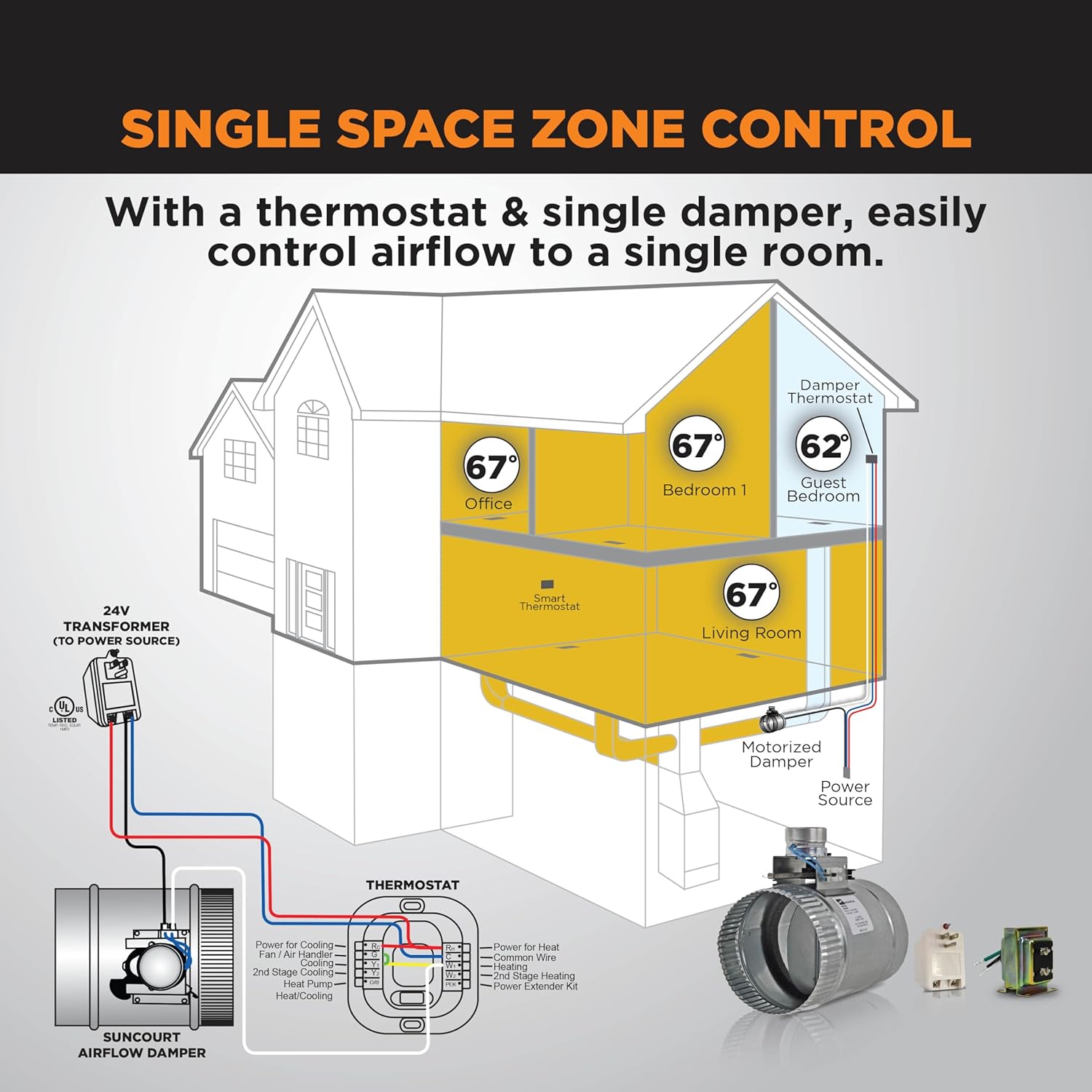
When the upstairs zone is satisfied, the control board closes the dampers leading to the upper level. The system diverts all conditioned air to the lower level where heating or cooling is still required. This selective routing prevents the over-conditioning of unoccupied spaces.
Advanced two-zone setups often pair with variable-speed inverter compressors. When a single zone closes off, an inverter compressor reduces its speed and refrigerant flow to match the smaller load. It sips electricity rather than running at full blast.
Old single-stage equipment paired with zoning requires a bypass dump zone or a relief valve. When half the ducts close, static pressure spikes inside the main trunk line. A bypass loop routes excess air back into the return duct, which somewhat diminishes total efficiency gains.
Side-by-Side Comparison: 1 Zone vs 2 Zones
Comparing these two configurations highlights clear operational differences in cost, comfort, and complexity.
| Feature | 1-Zone System | 2-Zone System |
|---|---|---|
| Thermostats | Single central thermostat | Two independent thermostats |
| Air Distribution | All registers open continuously | Motorized dampers regulate airflow |
| Temperature Balance | Prone to hot and cold spots | Highly uniform across levels |
| Initial Installation Cost | Lower equipment and labor expense | Higher due to panels, dampers, and wiring |
| Energy Efficiency | Lower in multi-story or sprawling homes | Higher when utilizing strategic setbacks |
Single-zone systems win on upfront simplicity and lower initial installation costs. They require fewer moving parts, which means fewer components can fail over time. However, they sacrifice comfort and monthly efficiency in multi-story or complex floor plans.
Two-zone setups require a larger upfront investment for control boards, motorized dampers, and extra thermostats. They demand careful manual J load calculations to ensure proper airflow balancing. For homeowners planning to stay in their house long-term, the ongoing utility savings usually offset that initial expense.
Frequently Asked Questions
Does closing a zone cut my energy bill in half?
No, closing a zone does not cut your energy bill in half. HVAC equipment still consumes baseline power to run blower motors and maintain minimum compressor cycles. Furthermore, heat transfers through interior walls from conditioned rooms to unconditioned rooms, meaning your system still works to offset that thermal bleed.
Do I need a special HVAC unit for a 2-zone system?
You can install a 2-zone system on many existing ducted HVAC units using a zone control panel and motorized dampers. However, variable-speed or multi-stage equipment works much better with zoning. Single-stage systems require bypass dampers to manage excess static pressure when zones close.
Which is better for a two-story home?
A 2-zone system is much better for a two-story home because it solves the natural stack effect. Heat rises and makes second floors uncomfortably warm during summer months. Zoning lets you send extra cooling upstairs without freezing the ground floor.
How much does it cost to retrofit a 2-zone system?
Retrofitting a 2-zone system into an existing house typically costs between two thousand and four thousand dollars. The price varies based on your duct layout accessibility and whether electrical wiring must be run through finished walls for the new thermostat.
The Real Power Consumption Difference: Does Cutting a Zone Cut Your Bill in Half?
Closing off one half of your home does not slash your monthly electric bill in half. HVAC compressors and blower fans consume baseline electrical power just to operate, regardless of how many ducts are open. Thermal energy also bleeds through interior walls from conditioned rooms into unconditioned spaces, meaning your system still works to fight that heat transfer.
Aggregate user reviews and field studies from the U.S. Department of Energy indicate real-world savings usually range from fifteen to thirty percent. The exact power draw reduction depends heavily on your compressor type.
Single-stage units continue running at full capacity even when a zone closes, relying on a bypass damper to dump excess air.
Variable-speed inverter systems yield much better power savings in a two-zone setup. When a motorized damper shuts, an inverter compressor scales back its rotational speed and refrigerant flow. It draws significantly fewer watts because it matches the smaller thermal load rather than blasting conditioned air at maximum output.
Your daily scheduling habits dictate your actual savings. If you keep both zones at identical temperatures around the clock, a zoned system saves almost nothing. You only see lower kilowatt-hour usage when you actively set back unoccupied zones by several degrees during work hours or overnight.
The Hidden Energy Traps: Static Pressure and Compressor Short-Cycling
Zoning your home introduces mechanical challenges that can inadvertently spike your power consumption if left unmanaged. When motorized dampers snap shut, your ductwork static pressure rises instantly. If your HVAC blower motor lacks variable-speed capability, it works much harder against that closed resistance, drawing extra electricity and straining mechanical parts.
High static pressure also reduces overall airflow across your furnace heat exchanger or cooling coil. Restricted airflow in cooling mode can cause the evaporator coil to freeze, shutting down your system entirely. In heating mode, low airflow traps heat inside the furnace cabinet, tripping high-limit safety switches and shortening equipment lifespan.
Compressor short-cycling is another major risk in improperly balanced two-zone configurations. If a zone is too small, it reaches the target temperature in just a few minutes and shuts off the system prematurely. Rapid cycling consumes a massive surge of startup amperage every time the compressor kicks back on, driving up your power bill and wearing out the motor windings.
Proper installation requires a professional Manual J load calculation to size your ductwork and zone split correctly. Technicians often install a bypass damper or configure a pressure-relief bleed to prevent static pressure spikes. Avoiding these mechanical traps ensures your system operates at peak efficiency.
Best Use Cases: When a 2-Zone System Makes Financial Sense
A two-zone setup makes the most financial sense in multi-story homes with severe temperature stratification. If your second floor traps heat and stays twenty degrees warmer than your ground floor, a single thermostat leaves everyone uncomfortable. Splitting the home into an upstairs zone and a downstairs zone solves this distribution problem directly.
Homes with expansive floor plans or large additions also benefit greatly from multi-zone control. If you have a sprawling ranch-style house where the east wing bakes in the morning sun while the west wing stays shaded, zoning lets you direct cooling where it is needed most. You stop wasting electricity over-conditioning rooms that sit empty during specific parts of the day.
Households with distinct occupancy schedules gain substantial utility savings from a 2-zone configuration. If you work in a home office on the top floor during daytime hours, you can keep that zone comfortable while setting back the unoccupied lower level. Conversely, you can cool the main living areas in the evening while letting the empty bedrooms drift.
If you live in a single-story home with an open-concept layout and uniform solar exposure, a 2-zone upgrade rarely makes financial sense. The installation cost of control panels and motorized dampers will take decades to recover through utility savings. Whole-house single-zone conditioning is simpler and more cost-effective in compact, well-insulated spaces.
Common Mistakes That Spike Energy Consumption in Zoned Systems
Homeowners often make simple scheduling errors that completely negate the efficiency benefits of a zoned system. Setting extreme temperature setbacks, such as turning a zone off entirely in freezing weather, forces your HVAC system to work at maximum capacity for hours just to recover. Moderate setbacks of three to five degrees preserve energy much more effectively.
Another frequent mistake is closing room supply vents manually while using a zoned system. HVAC zoning relies on calculated airflow paths to manage static pressure across the entire duct network. Closing individual registers disrupts that careful balance, forcing your system to fight against unexpected air resistance and consume extra power.
Failing to change your air filters regularly causes severe efficiency drops in zoned configurations. As filters load up with dust, airflow restriction combines with closed zone dampers to create extreme static pressure. Your blower motor ramps up its wattage draw to compensate for the blocked airflow, driving up your monthly power bill.
Neglecting annual professional maintenance leads to failing motorized dampers and inaccurate thermostat calibration. If a zone damper sticks halfway open or closed, your system heats or cools the wrong areas without your knowledge. Regular inspections ensure every component communicates properly and operates at peak efficiency.
Final Verdict: Is Upgrading to a 2 Zones Worth the Investment?
Upgrading from a 1-zone to a 2-zone HVAC system is worth the investment if your home suffers from persistent temperature imbalances. Multi-story houses, homes with large glass exposures, and properties with distinct occupancy patterns see immediate comfort gains and noticeable utility savings. The ability to target conditioned air where you actually spend your time eliminates chronic hot and cold spots.
If your current single-zone system maintains uniform comfort across your entire living space, an expensive zoning retrofit will not pay for itself. The high upfront cost of control panels, motorized dampers, and professional balancing requires many years of utility savings to recover. Evaluate your daily living habits and home layout before committing to the upgrade.
Pairing a 2-zone setup with a modern variable-speed compressor yields the highest possible energy efficiency. Inverter technology allows your equipment to scale its power draw down when zones close, preventing the short-cycling issues common with older single-stage units. Consult a licensed HVAC professional to review your specific duct layout and run a proper load calculation.